A collaborative research team led by Professor Wang Can from the School of Environment at Tsinghua University and Professor Joeri Rogelj from the Centre for Environmental Policy at Imperial College London has developed a pioneering, equity-based framework to determine the warming impact of national climate pledges under the Paris Agreement.
The study, which integrates principles of international environmental law, normative theories, and quantitative modeling with the latest climate science, arrives at a critical juncture. As nations prepare to submit their updated Nationally Determined Contributions (NDCs) in 2025, the findings offer vital academic and political insights into advancing fairness in global climate action.
Under the Paris Agreement, NDCs are required to reflect the principle of equity. However, achieving international consensus on what constitutes a “fair share” of emission reductions has remained a persistent challenge. Existing literature often suffers from two primary limitations: a lack of transparency regarding the normative choices behind quantification processes, and a reliance on proxy indicators—such as CO2 emissions alone—rather than a direct measure of a country’s actual contribution to global temperature rise.
To address these gaps, the research team proposed a novel method for allocating warming contributions based on three principles aligned with international environmental law. The framework aims to rectify historical inequities while ensuring that global warming remains limited to 1.5℃, targeting net-zero CO2-equivalent warming emissions by 2050. By analyzing the total global warming contribution from 1850 to 2050, the team calculated the projected allowable contributions for nations after 2021, accounting for both historical responsibilities and methodological uncertainties.
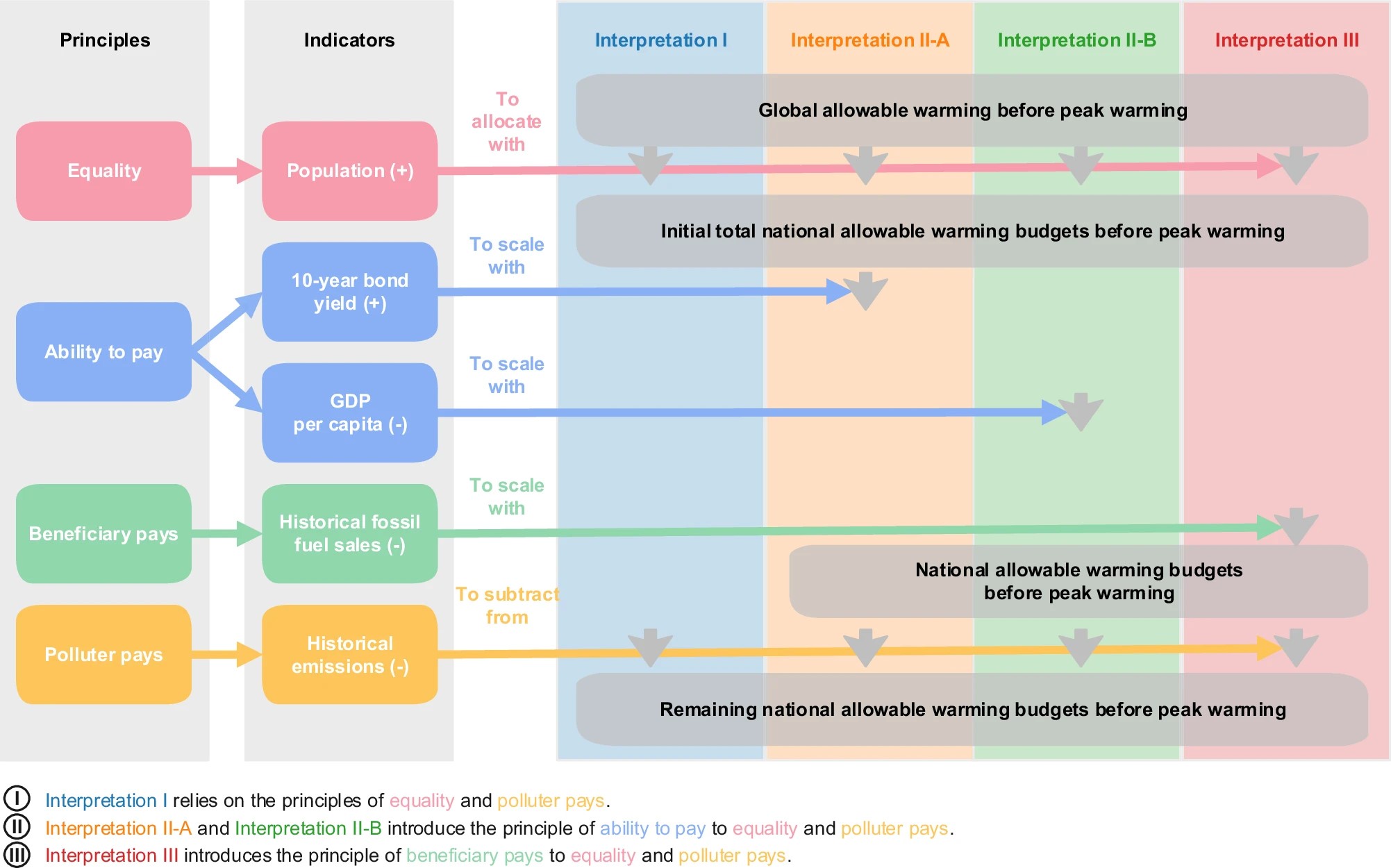
Fig. 1: Analysis framework linking principles, indicators, and the allocation procedure to estimate fair global warming contributions.
The study reveals a stark disparity in projected contributions between countries with very high, high, medium, and low levels of human development. According to the research, 84 to 90 countries—including nearly all major developed nations—had already exhausted their projected warming contributions for a 1.5℃ target (50% probability) by 2021. A similar trend was observed for the 2°C target (67% probability).
The results indicate that even if these nations implement NDCs representing their maximum technically feasible mitigation efforts, they will likely still exceed their fair warming allocations. This "overdraft" underscores a significant gap between current domestic capabilities and ethical responsibilities.
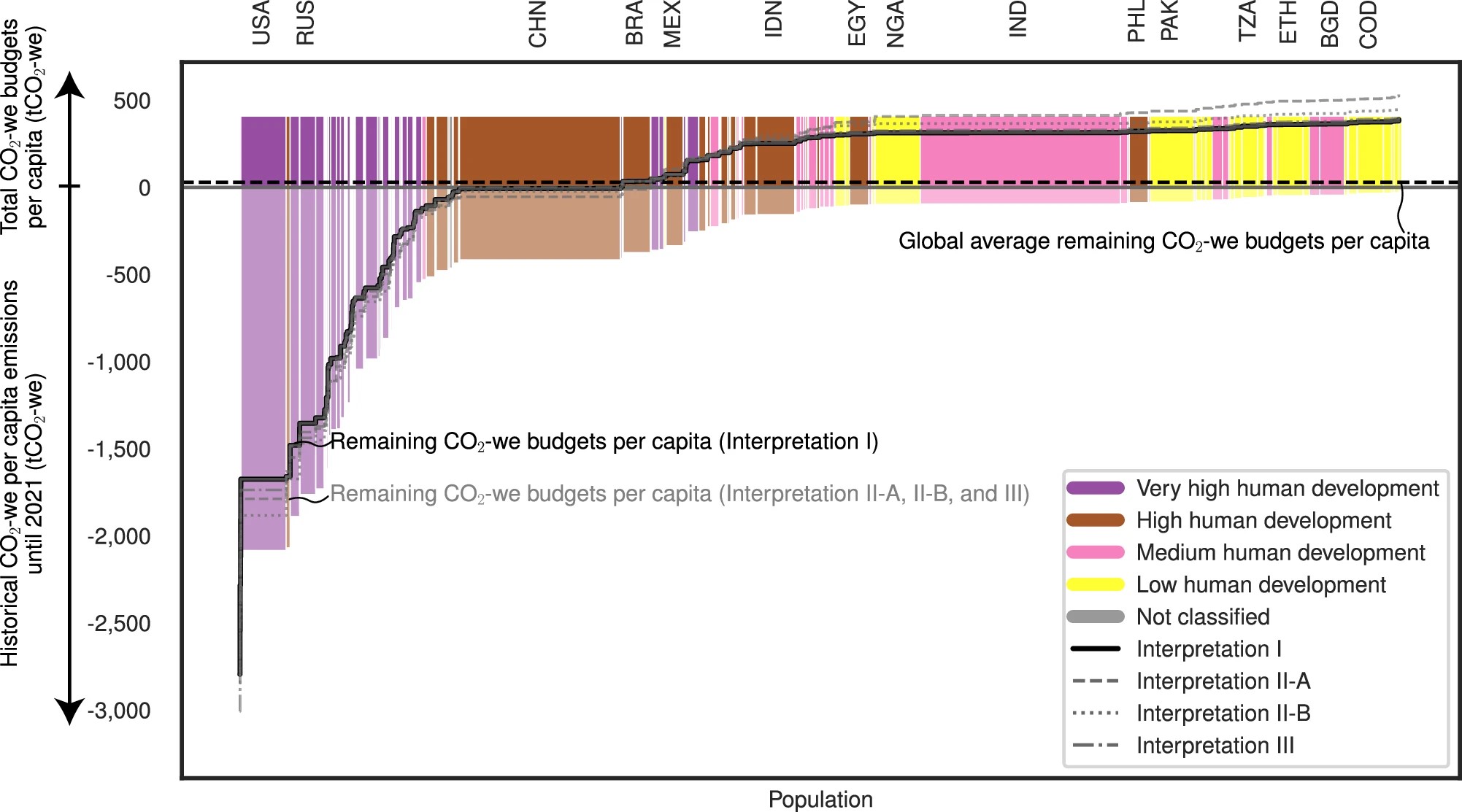
Fig. 2: Total (1850–2050), historical (1850–2021), and remaining (2022–2050) CO2 warming equivalent budgets per capita by country.
The study emphasizes that for nations unable to meet their equity obligations through domestic mitigation alone, there is an urgent moral imperative to take additional measures. The authors suggest that these countries must pursue deeper domestic decarbonization and significantly scale up Carbon Dioxide Removal (CDR) technologies to contribute effectively to the global climate challenge.
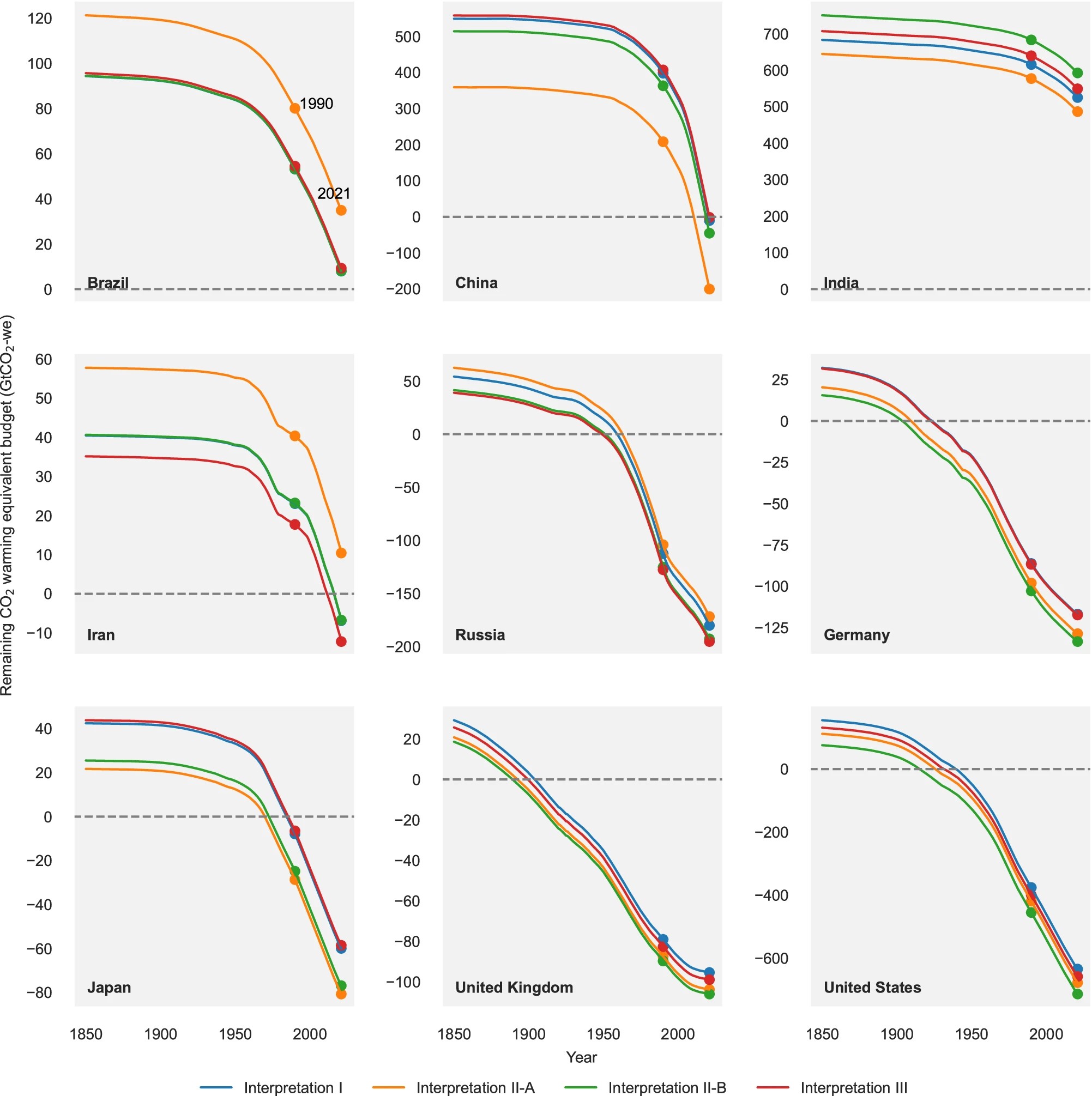
Fig. 3: The depletion of remaining CO2 warming equivalent emission budgets over time.
The research was published online on January 26 in the prestigious journal Nature Communications under the title “A principle-based framework to determine countries’ fair warming contributions to the Paris Agreement.”
Li Mingyu, a PhD candidate (Class of 2019) at Tsinghua University’s School of Environment, is the lead author of the paper. Professor Joeri Rogelj serves as the corresponding author, with Professor Wang Can, Setu Pelz (International Institute for Applied Systems Analysis), and Robin Lamboll (Imperial College London) serving as co-authors. The research was completed during Li Mingyu’s joint PhD training at Imperial College London (2023–2024), supported by the China Scholarship Council and the National Natural Science Foundation of China.
Paper Link: https://www.nature.com/articles/s41467-025-56397-6