A collaborative research team led by Associate Professor Geng Guannan from Tsinghua University’s School of Environment (SOE) has developed a comprehensive assessment framework for multi-objective synergistic governance. This framework integrates bottom-up emission projections, target-oriented emission reduction optimization, air quality modeling, and cost-benefit analysis. By merging clean air and climate policies, the research team quantified the mitigation effectiveness of CO2, PM2.5, and O3 across various scenarios, systematically exploring the feasibility and key strategies for achieving “triple synergy” in the near and medium term.
The study addresses a critical challenge in environmental governance. While China has seen dramatic improvements in air quality since 2013, PM2.5 levels remain relatively high, and ozone pollution has become an increasingly urgent issue. Although CO2 and PM2.5 often share common emission sources, the overlap between CO2 and ozone precursors—specifically volatile organic compounds (VOCs)—is much lower. This lack of homology, combined with the complex, non-linear way ozone forms in the atmosphere, has historically made it difficult to design a single policy that addresses all three pollutants effectively.
The study reveals that only a combination of strict air quality controls and aggressive climate action can ensure a stable transition. Under this synergistic scenario, China’s CO2 emissions could peak as early as 2025. By 2030, national annual average PM2.5 concentrations are projected to drop to 19.1μg/m3, and ozone levels are expected to fall within safer thresholds. Furthermore, this integrated approach would be more resilient to unpredictable weather patterns and is estimated to generate a net economic benefit of over 3 trillion RMB.
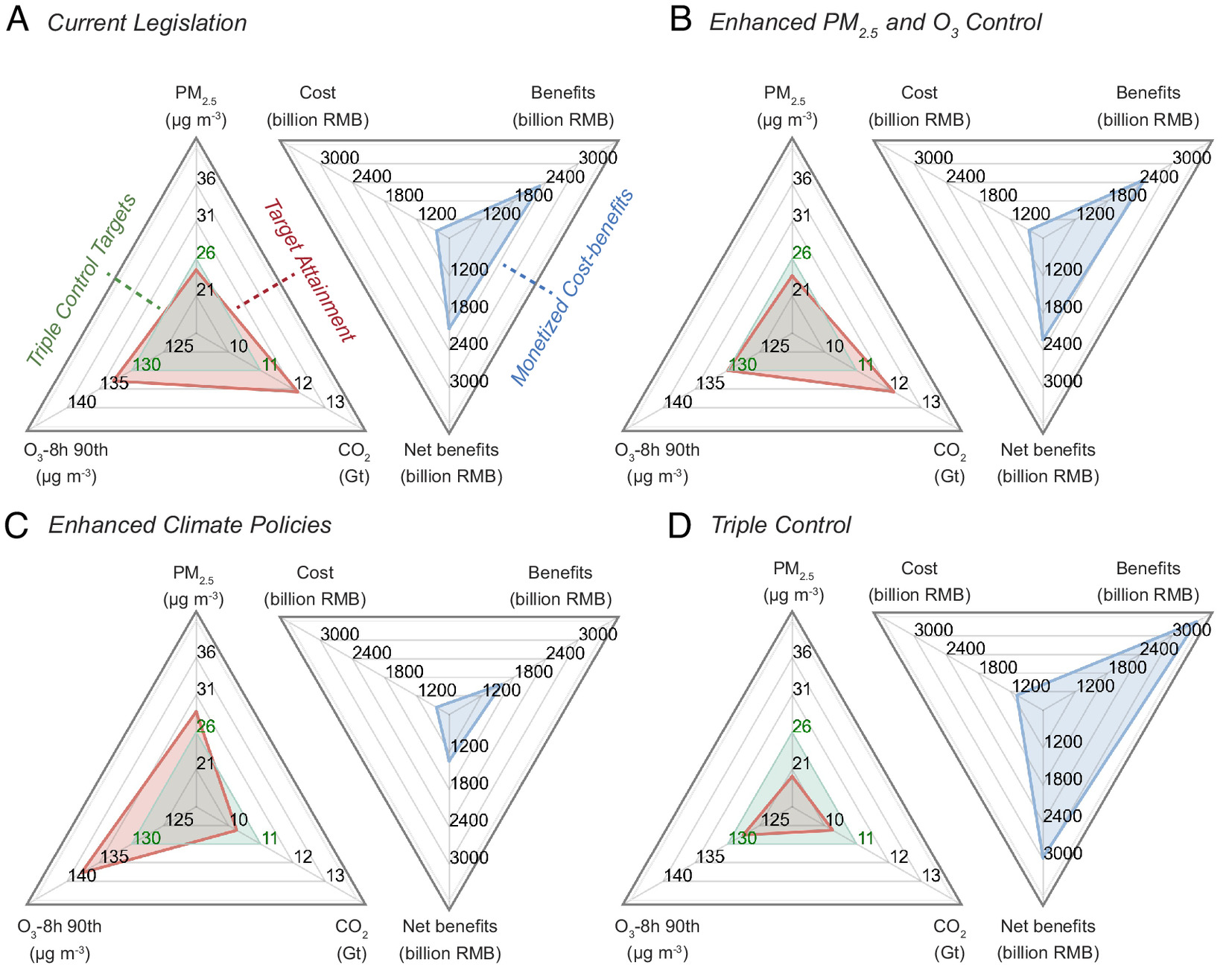
Figure 1. Achievement of PM2.5, O3, and CO2 targets and corresponding environmental, climate, and economic benefits under different synergistic governance pathways.
Beyond long-term climate targets, the research highlights that low-carbon policies are essential even for immediate air quality goals. The team recommends a prioritized implementation of high-efficiency measures, such as the electrification of diesel vehicles and the transition to clean energy for residential heating. Simultaneously, they emphasize that closing the “gap” in ozone control requires intensified end-of-pipe treatments for industrial coatings and petrochemicals to reduce VOC emissions.
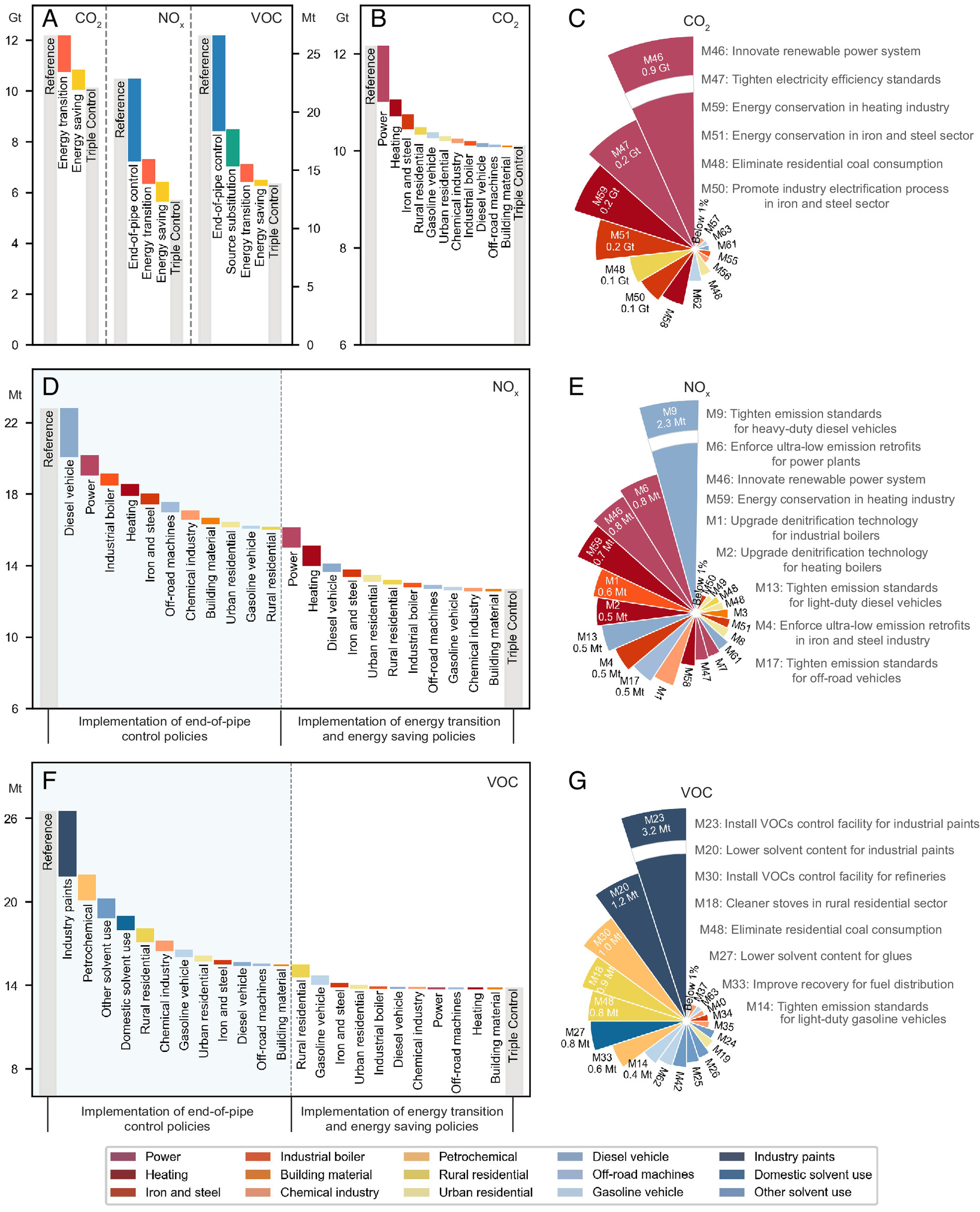
Figure 2. Emission reduction contributions of major air pollutants and CO2 by sector and measure.
This research not only provides a technical foundation for the “Beautiful China” initiative but also offers a valuable reference for other developing nations facing the dual pressures of climate change and air pollution.
The findings were published in the Proceedings of the National Academy of Sciences of the United States of America (PNAS) on November 10 titled “Strategy for coordinating near-term PM2.5, ozone, and CO2 mitigation in China.”
The co-first authors of the paper are Dr. Liu Yuxi (a joint postdoctoral fellow at Tsinghua University and the Chinese Academy of Environmental Planning) and Associate Researcher Zheng Yixuan (Chinese Academy of Environmental Planning). Associate Professor Geng Guannan is the corresponding author. Co-authors include Academician He Kebin, Professor Zhang Qiang, and Associate Professor Tong Dan. The study was supported by the National Natural Science Foundation of China and the Energy Foundation.
Paper Link: https://www.pnas.org/doi/10.1073/pnas.2513194122