On the opening day of the 2025 Shanghai International Carbon Neutrality Expo, the Carbon Footprint Industry Alliance officially launched the Tiangong LCA Data System (TIDAS). This pioneering system is designed to provide a scientific, comprehensive, and forward-looking solution for Life Cycle Assessment (LCA) and the construction of carbon footprint databases. As part of the “Tiangong” open-source ecosystem, TIDAS aims to become the “Android system” for LCA and carbon footprint databases both in China and globally.
Establishing a product carbon footprint management system is vital to China’s green and low-carbon development mechanisms and a key pillar in the advancement of its ecological civilization system. However, the field of LCA and carbon footprint databases has long been hindered by inconsistent standards, incompatible data structures, and a lack of interconnectivity. These bottlenecks have historically slowed the pace of database construction and limited data sharing and application. Existing international frameworks, though robust in theory, often face significant operational challenges when attempting to achieve direct interoperability between different databases.
Professor Xu Ming, Secretary-General of the Carbon Footprint Industry Alliance and Associate Dean of the School of Environment at Tsinghua University, introduced TIDAS at the launch. The system comprises technical guidelines for LCA database construction, standardized data structures, foundational datasets, and a suite of open-source tools, enabling seamless interconnectivity between databases and is fully compatible with mainstream international data systems. It empowers developers to build databases efficiently, and its core conceptual and technical innovations are expected to lead the industry on an international level.
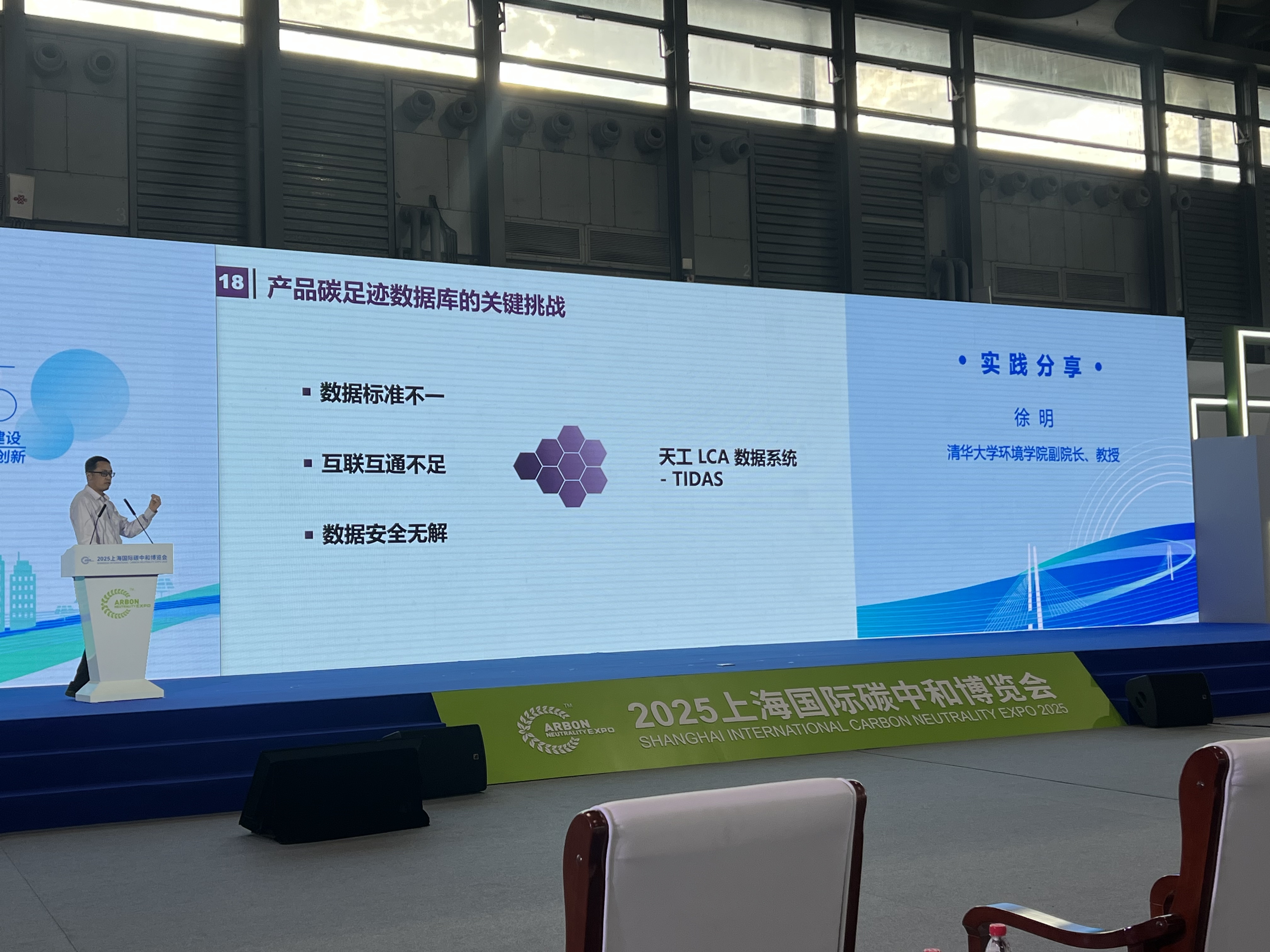
Launch of the TIDAS System at the Carbon Expo
TIDAS is fully Open-Source. All of its documents, technologies, and tools are free to access, promoting industry-wide collaboration. Databases developed under the TIDAS framework can connect directly without complex adaptation or conversion. It has high global compatibility. TIDAS is fully compatible with international systems such as ILCD/eILCD, allowing for two-way, lossless data conversion to help local data integrate into global supply chains. What’s more, the system natively supports Artificial Intelligence (AI), Blockchain, and Trusted Data Spaces, ensuring secure and efficient data collaboration.
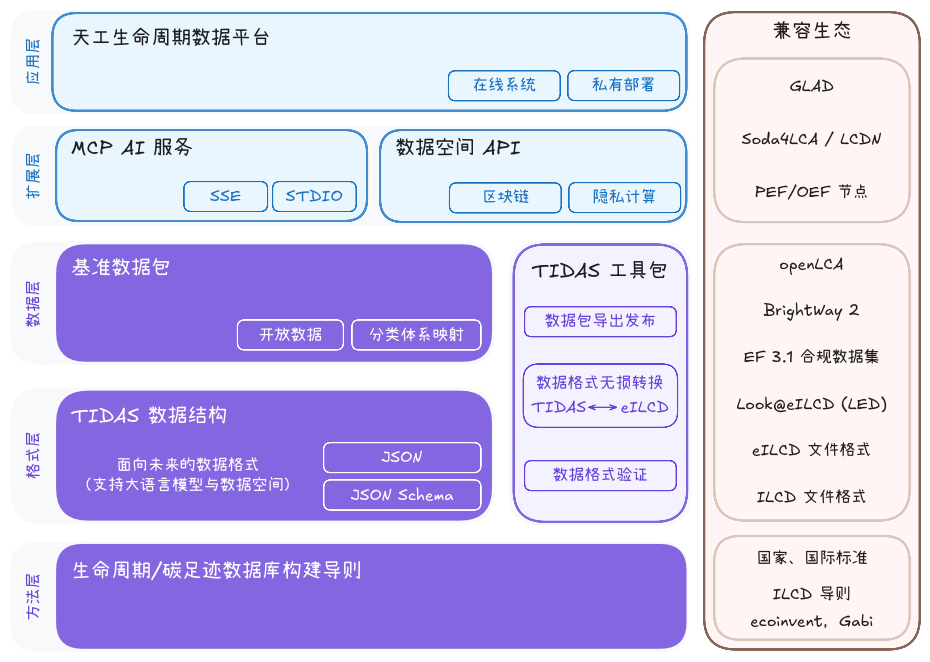
TIDAS System Architecture Diagram
He Kebin, Academician of the Chinese Academy of Engineering and Dean of the Institute for Carbon Neutrality at Tsinghua University, emphasized that TIDAS provides an “out-of-the-box” solution. It addresses common methodological hurdles, allowing government departments, industry associations, and enterprises to build high-quality databases with autonomy and efficiency.
The system also integrates Ant Digital Technologies’ blockchain and trusted data collaboration platforms. Li Zhenhua, Vice Chairman of the Alliance and Dean of the Ant Group Research Institute, noted that the fusion of AI and blockchain will drive the next generation of carbon footprint management.
From an industrial perspective, Jiang Li, Vice President of CATL and Chairman of its Sustainable Development Committee, stated: “TIDAS’s seamless compatibility with mainstream systems like the EU’s will provide a governance framework for enterprises to manage green supply chains and respond effectively to international trade requirements.”
The release of TIDAS marks the first time a comprehensive “China Solution” has been proposed to tackle the global challenges of LCA data systems. The Carbon Footprint Industry Alliance has already entered into technical cooperation with the United Nations Environment Programme (UNEP) to provide global LCA data management solutions based on TIDAS, contributing Chinese expertise to the global pursuit of sustainability.
Editor: Zhang Nannan